
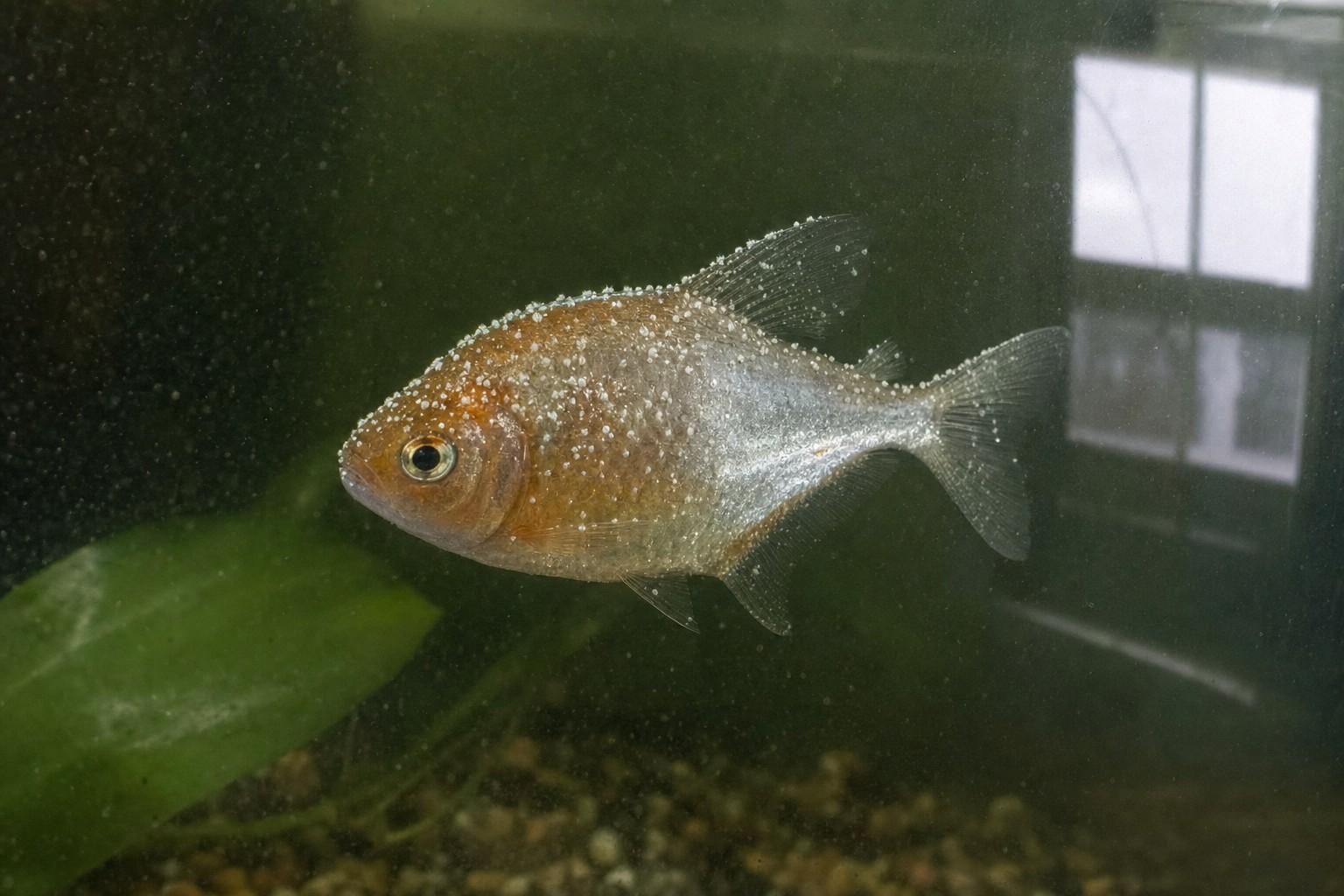
A fish that looked normal yesterday is suddenly dusted with tiny white grains, scattered across its body and fins like someone tipped salt over it.
That’s the classic look of ich, the most common disease in freshwater aquariums.
Most signs of a sick fish are vague: lethargy, clamped fins, a fish hiding more than usual. Ich isn’t one of those.
It’s one of the few signs of a sick fish that comes with a name attached, and a known cause rather than a guess.
The spots you can see are not the stage a treatment can actually reach.
That’s what explains the confusing part: spots that don’t disappear right away, and a single dose that rarely finishes the job.
What’s causing the white spots
The parasite responsible is Ichthyophthirius multifiliis, usually just called ich.
According to the University of Florida’s IFAS Extension, it moves through three distinct stages. Each one behaves differently in the tank.
That’s the detail most home treatment gets wrong. People treat the fish, when what actually needs treating is the water, and only at one specific point in the parasite’s life.
Only one of ich’s three stages is actually exposed to anything you add to the water.
Three stages, and only one you can reach
Here’s what’s happening at each point in the cycle:
- Trophont: feeds under the fish’s skin and gill tissue. This is the stage that causes the visible white spots, and the fish’s own mucus and epithelial tissue shield it from anything in the water.
- Tomont: once it’s done feeding, it drops off the fish onto the substrate or tank surfaces and encysts. Inside a tough gelatinous cyst wall, it divides repeatedly, protected the same way as the trophont.
- Theront: free-swimming and searching for a new fish to infect. With no fish tissue and no cyst wall around it, this is the one stage a treatment can actually reach.
Everything about ich’s stubbornness comes down to which stage is exposed, and which isn’t.
A single tomont can split into as many as 1,024 new parasites before it’s finished dividing. All of them wait to hatch as theronts.
That’s the whole reason a fish covered in spots doesn’t clear up after one dose. The parasites doing visible damage right now are untouchable.
Treatment is waiting for them to finish feeding, drop off, encyst, multiply, and eventually release free-swimming young. That’s the only point where anything in the water can reach them.
Temperature sets the clock
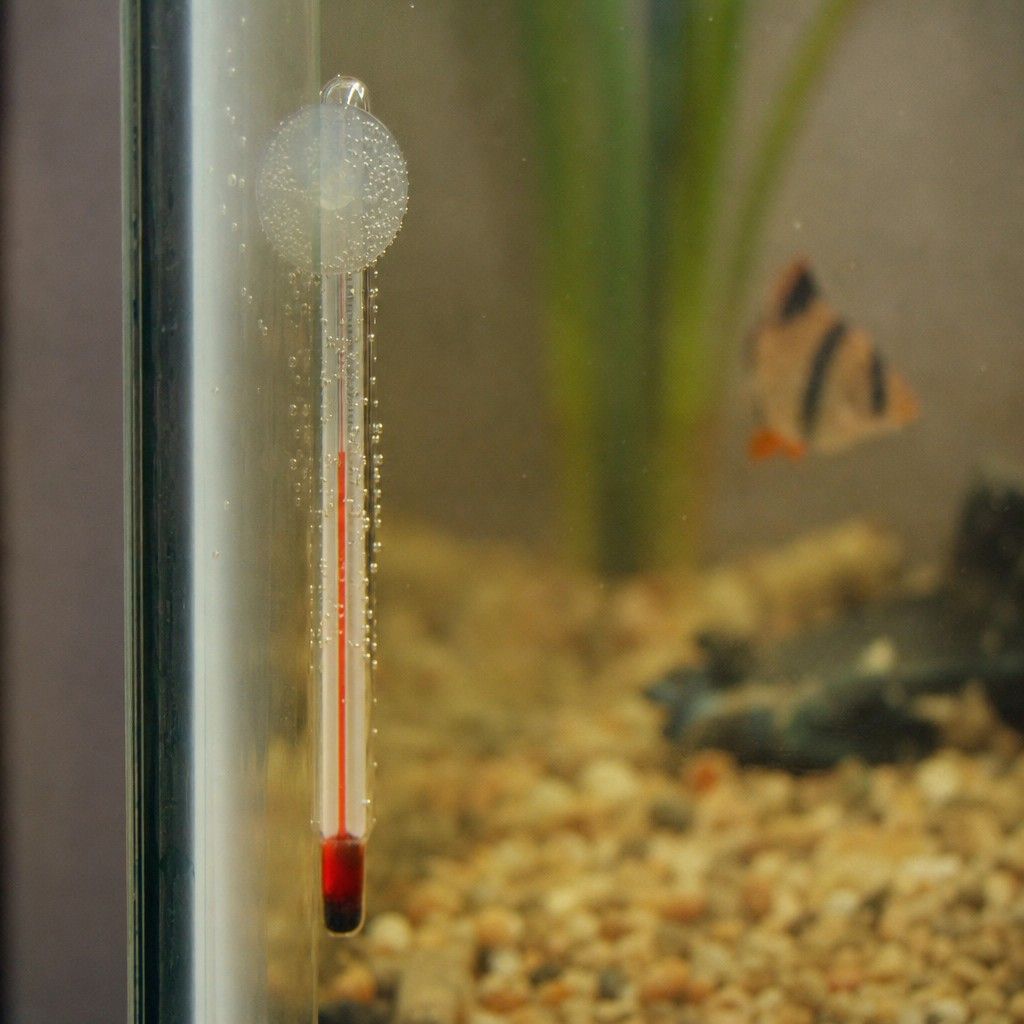
Ich’s life cycle isn’t fixed. It runs on temperature, and that turns out to matter for how treatment gets timed.
At a warm 75 to 79°F, the whole cycle from feeding to free-swimming young wraps up in about 3 to 6 days, according to IFAS Extension.
In cooler water, closer to 60°F, that same cycle stretches out over weeks instead of days. Cool-water guidance calls for spacing doses 3 to 5 days apart, with a minimum of five treatments, to cover enough hatching windows.
Roughly, the difference looks like this:
- Warm tank (75 to 79°F): full cycle completes in about 3 to 6 days.
- Cool tank (around 60°F): cycle stretches to weeks; treatments need spacing 3 to 5 days apart, at least five rounds.
That’s the logic behind gradually raising a tank’s temperature during an outbreak. A faster cycle means the vulnerable stage shows up sooner and more often, which gives treatment more chances to reach it.
It isn’t safe for every species or every tank. Check what the fish involved can actually tolerate before pushing the heater up.
What treatment at home usually involves
A few approaches show up again and again once ich is confirmed:
- Raising the tank’s temperature gradually, within a safe range for the fish involved, to speed the parasite along toward its vulnerable stage.
- Aquarium salt as one option in smaller systems. IFAS Extension guidance describes a salinity of 4 to 5 grams per liter, held for 7 to 10 days. Not every plant or scaleless fish tolerates aquarium salt well.
- Regular water changes pull free-swimming parasites out of the water. They also support the same weekly maintenance routine that keeps a tank stable the rest of the time.
- Following the medication through its full stated course, even after the spots are gone. A clear-looking fish has parasites that dropped off, not parasites that are dead.
That last point trips people up the most.
Stopping early is one of the most common reasons ich seems to come back a few days later. It usually didn’t come back. It was never fully finished.
A tank can look completely clear for a day or two and still be mid-cycle.
The trophonts drop off on a schedule the fish doesn’t control. A clean-looking tank isn’t proof the outbreak is over.
None of this replaces an aquatic veterinarian’s judgment for a tank in real trouble. That’s especially true for a valuable collection, or fish already stressed beyond what ich alone would cause.
This is general information, not a diagnosis for a specific tank.
Where ich usually comes from
Ich doesn’t appear out of nowhere.
In most cases it arrives with something the tank didn’t have before, usually a new fish. Or it shows up after a stretch of stress the fish couldn’t shake off.
New fish are the classic route. A theront, or an already-encysted tomont, can travel in a bag of water from a store tank that looked completely healthy.
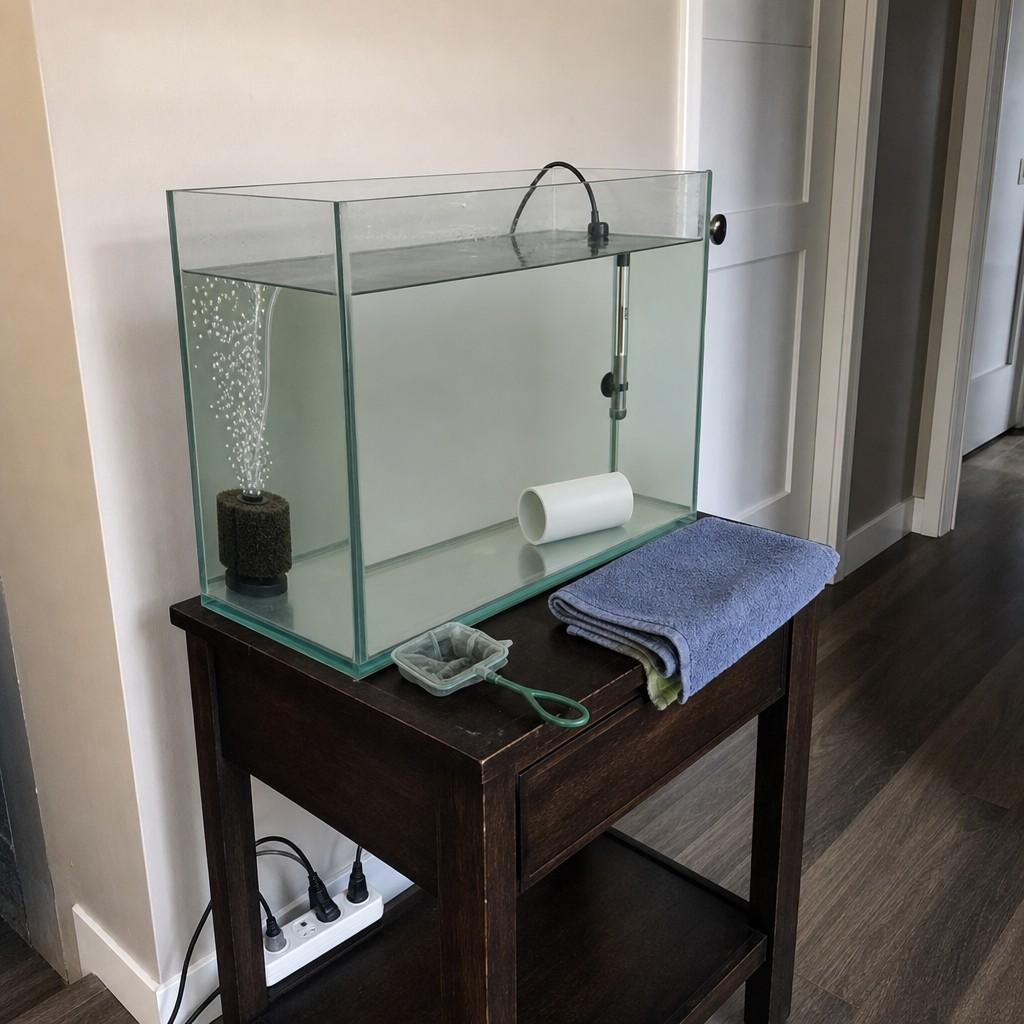
A short quarantine period for anything new gives early symptoms a chance to show up somewhere other than the main tank. That matters even before picking fish for a new tank is finished.
A short quarantine window is cheaper than an outbreak in the main tank.
Stress is the quieter route. A fish that’s been shipped, rehomed, or kept in swinging temperatures is more likely to come down with ich. So is a fish crowded into a tank that’s too small, even without new arrivals.
Most fish problems are water problems. Ich is a reminder that this holds even for a parasite. Poor water conditions and stress are what let it take hold in the first place.
The tank that handles ich well is usually the one that was already stable before the outbreak started.
A stable tank beats an impressive one, and that’s as true for keeping ich out as it is for anything else in the hobby.
New fish deserve a quarantine tank of their own. A stressed fish deserves calmer water, not more of it.
Most outbreaks trace back to one of those two things, which means most of them are preventable before the first white spot ever shows up.