
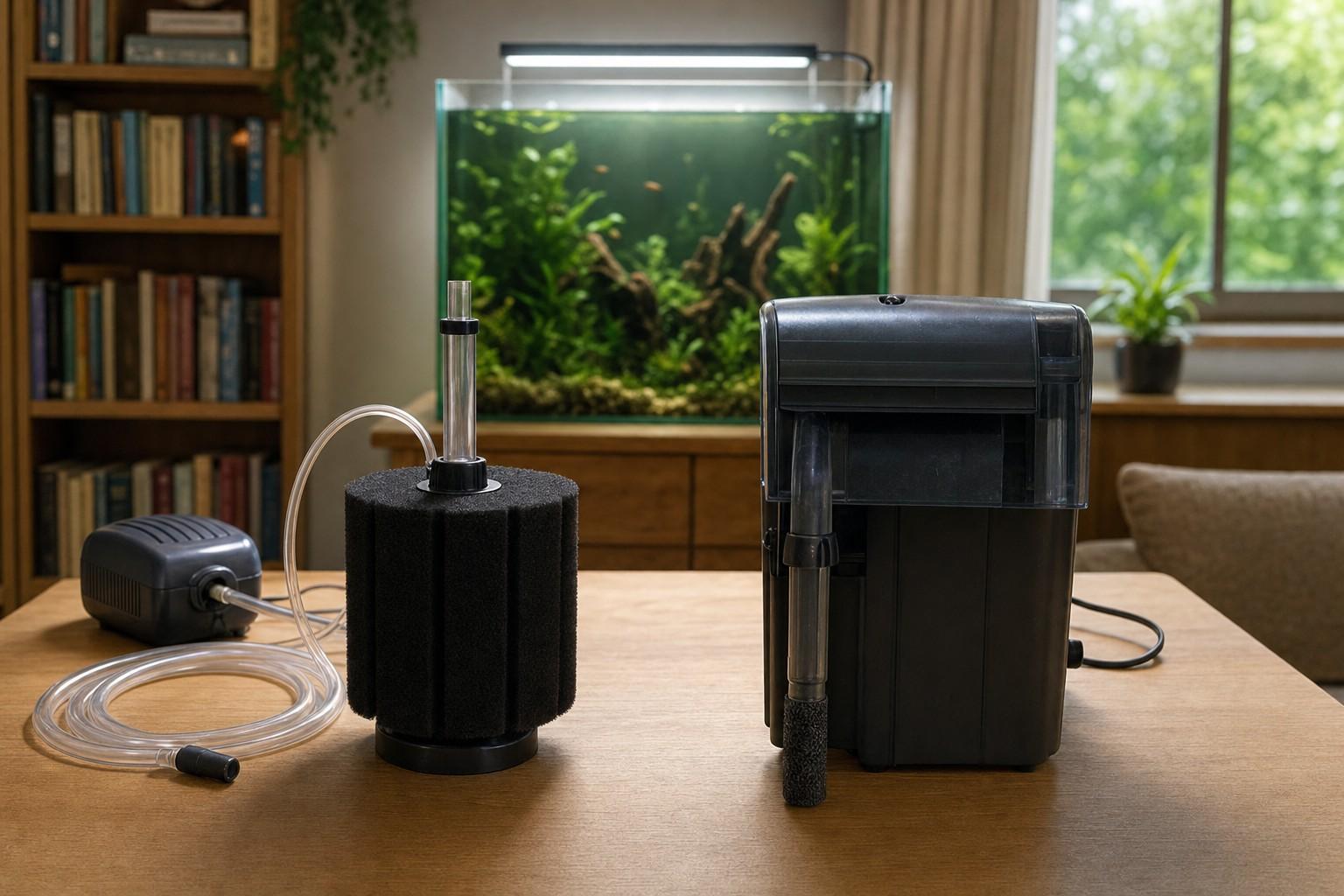
Most first-tank shoppers narrow the filter aisle down to two realistic choices. A sponge filter or a hang-on-back. Canisters cost more than a beginner needs. Internal filters are a step down in capacity. That leaves a genuine two-way decision.
If you buy through links on this page, Inside Aquatics may earn a small commission.
Both types do the core job well. Cycle the tank before you buy the fish, and either filter gives the bacteria a surface to live on.
The difference is in the daily experience of owning one.
How each one actually works
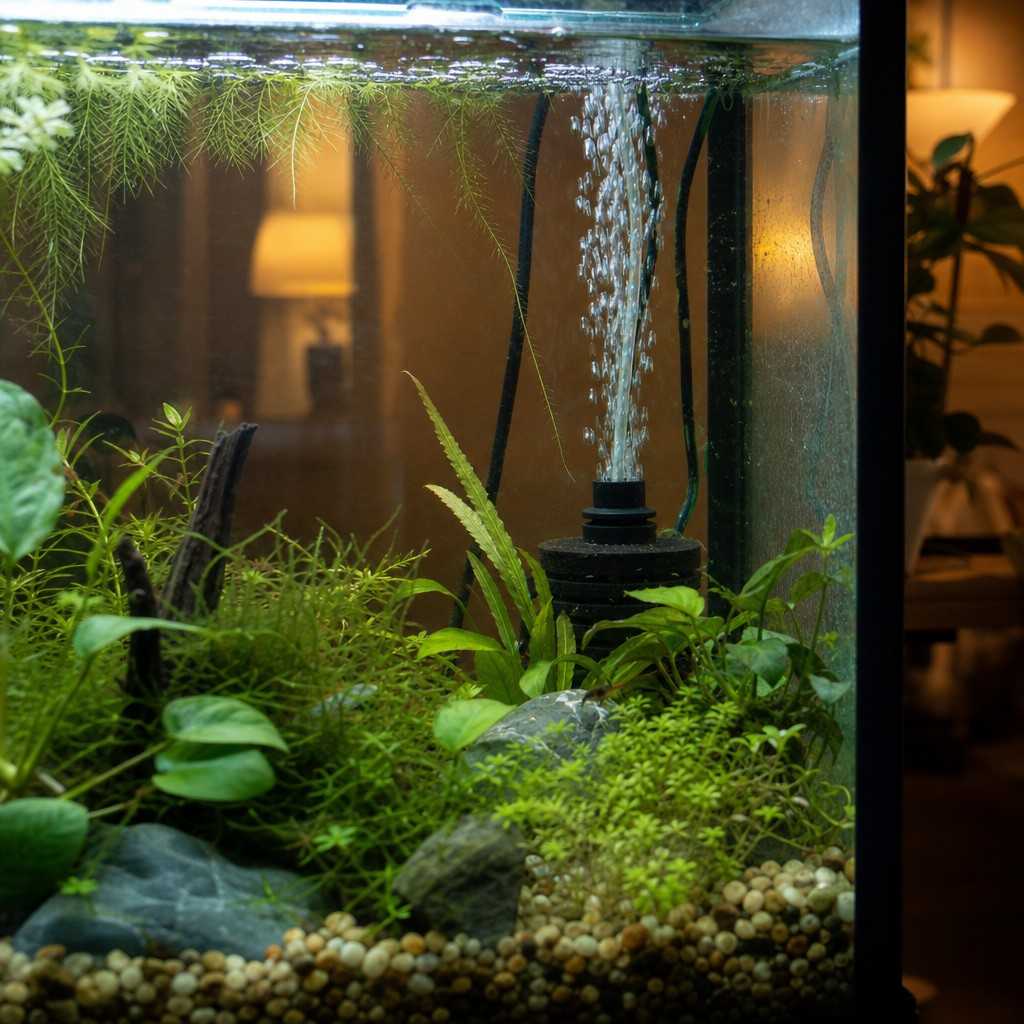
A sponge filter is a foam block that sits inside the tank. It’s driven by air from a pump that sits outside it. Water gets pulled through the foam, and bacteria colonize the surface.
There’s no motor in the water at all.
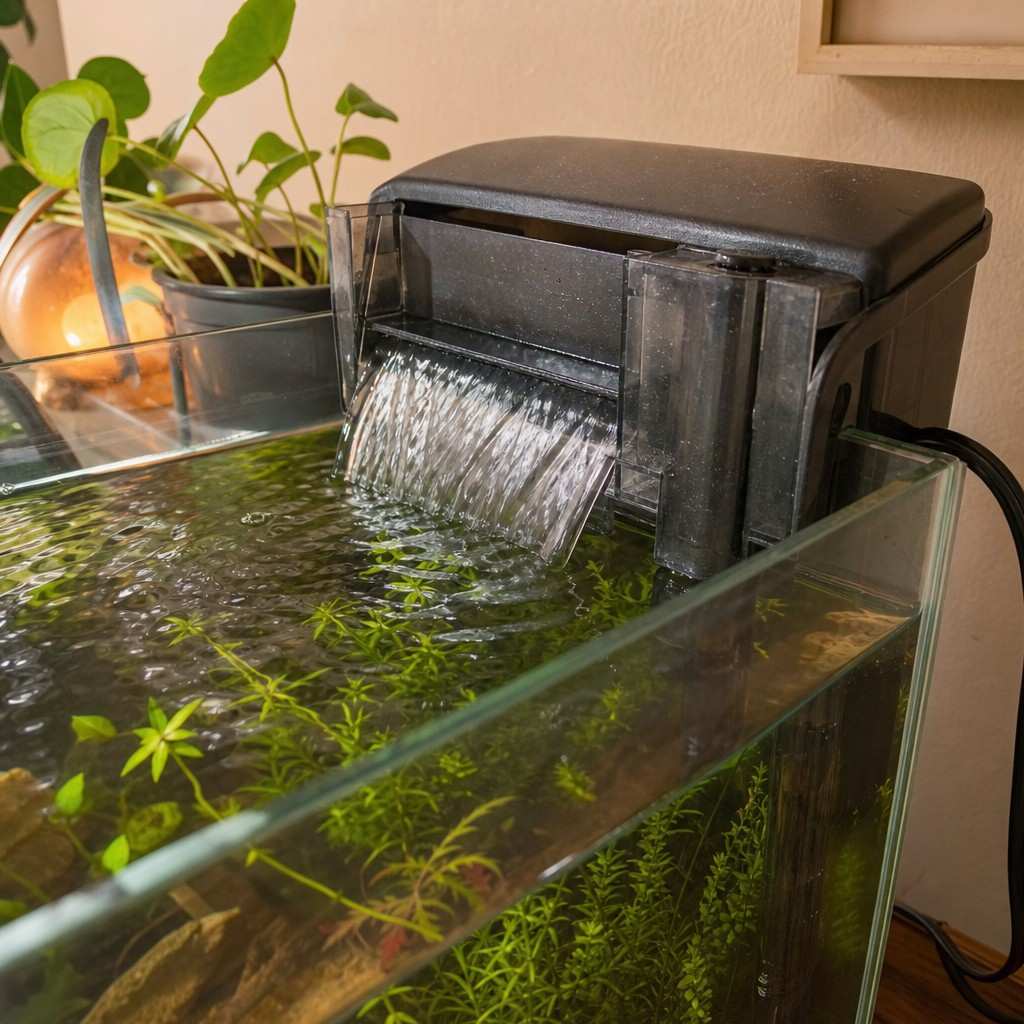
A hang-on-back filter clips to the rim and pulls water up through an intake tube. It runs on its own motor. It processes the water through media inside the housing, then spills it back over a small waterfall lip.
That mechanical difference explains almost everything else here: the sound, the flow, the maintenance, and the look.
Noise: a trickle versus a hum
An HOB’s motor is usually quiet. The water spilling back over the lip makes a soft, constant trickle. Most people find it pleasant, almost like background rain.
A sponge filter runs silent in the water. The noise comes from the air pump instead. That pump has to live somewhere, usually on a shelf or nightstand nearby.
Hobbyists commonly report that cheap air pumps develop an audible hum, especially at night when the room goes quiet. A better-made pump runs much quieter, but it’s a separate line item to budget for.
Neither sound is loud. Which one bothers you is personal, and worth testing in a store if you can.
The air pump: a cost the sponge filter doesn’t advertise
This is the honest catch with sponge filters. The filter itself is inexpensive, but it doesn’t run alone. It needs a separate air pump, airline tubing, and usually a check valve. That valve stops water from siphoning back if the power cuts out.
Add those together and total sponge-filter setup cost lands close to a mid-range HOB.
An aquarium air pump is not optional equipment here. It’s part of the purchase, even though it’s sold separately.
An HOB, by contrast, is one box. Everything needed is already inside it.
Flow strength: gentle versus standard
A sponge filter produces slow, soft flow. That gentleness is a feature, not a limitation, for certain fish. Bettas and fry tolerate weak current far better than strong current. Shrimp setups nearly always favor sponge filtration for the same reason.
An HOB pushes water through with more force. For most community fish, that flow is fine. It even helps keep the tank well mixed.
For a betta or a tank of young fry, the extra force can be too strong. It pushes small, slow swimmers around more than they’re built to handle.
Betta, shrimp, or fry-rearing tank: the sponge filter is usually the better match. For a general community tank of tetras or guppies, either works.
Media and ongoing cost
A sponge filter’s entire media is the foam itself. You rinse it in a bucket of tank water and put it right back. The same bacteria colony stays intact.
Nothing to buy again, beyond an occasional replacement sponge after a couple of years.
An HOB uses a cartridge, and this is where models diverge. Some cartridges are meant to be thrown away and replaced monthly. That habit strips out the bacteria that took weeks to establish. Others let you rinse and reuse the biological portion separately from the mechanical floss.
Look for the second kind. Over a year, a rinse-and-reuse HOB costs about the same to run as a sponge filter. A disposable-cartridge model adds a small but real recurring cost.
Looks: inside the tank versus behind it
A sponge filter sits inside the tank, visible through the glass. Airline tubing runs up over the rim. It’s not hidden, though some hobbyists tuck it behind a plant or decoration to soften the look.
An HOB hangs on the back instead, mostly out of view from the front. If a clean front-glass view matters to you, the HOB has the visual edge. Its body and waterfall spillway are still visible from the side and above.
When either one is genuinely fine
Take a standard ten-to-twenty-gallon community tank of tetras, platies, or corydoras. For fish like these, this isn’t a decision that can go wrong.
Both filters cycle a tank properly and keep the bacteria colony healthy. Pick by noise preference and budget, not by fear of the “wrong” choice.
Pick by situation
- Setting up a betta or a fry-rearing tank: choose the sponge filter for its gentle flow. Budget for the air pump as part of the real cost.
- Setting up a shrimp tank: the sponge filter again, for the same gentle-flow reason. Shrimp also can’t get pulled into an intake tube.
- Setting up a standard community tank, wanting one box that does it all: the HOB is the simpler purchase. AquaClear is a long-standing hang-on-back line hobbyists have used for decades.
- You’re sensitive to background noise: try the HOB’s water trickle over the air pump’s hum. Or budget for a quiet pump if you go the sponge route.
- You want the lowest possible recurring cost: the sponge filter’s rinse-and-reuse foam has no cartridge to replace. Just check the HOB you’re considering isn’t a disposable-cartridge model.
A stable tank beats an impressive one. Both of these filters, chosen for the right situation, get you there.