
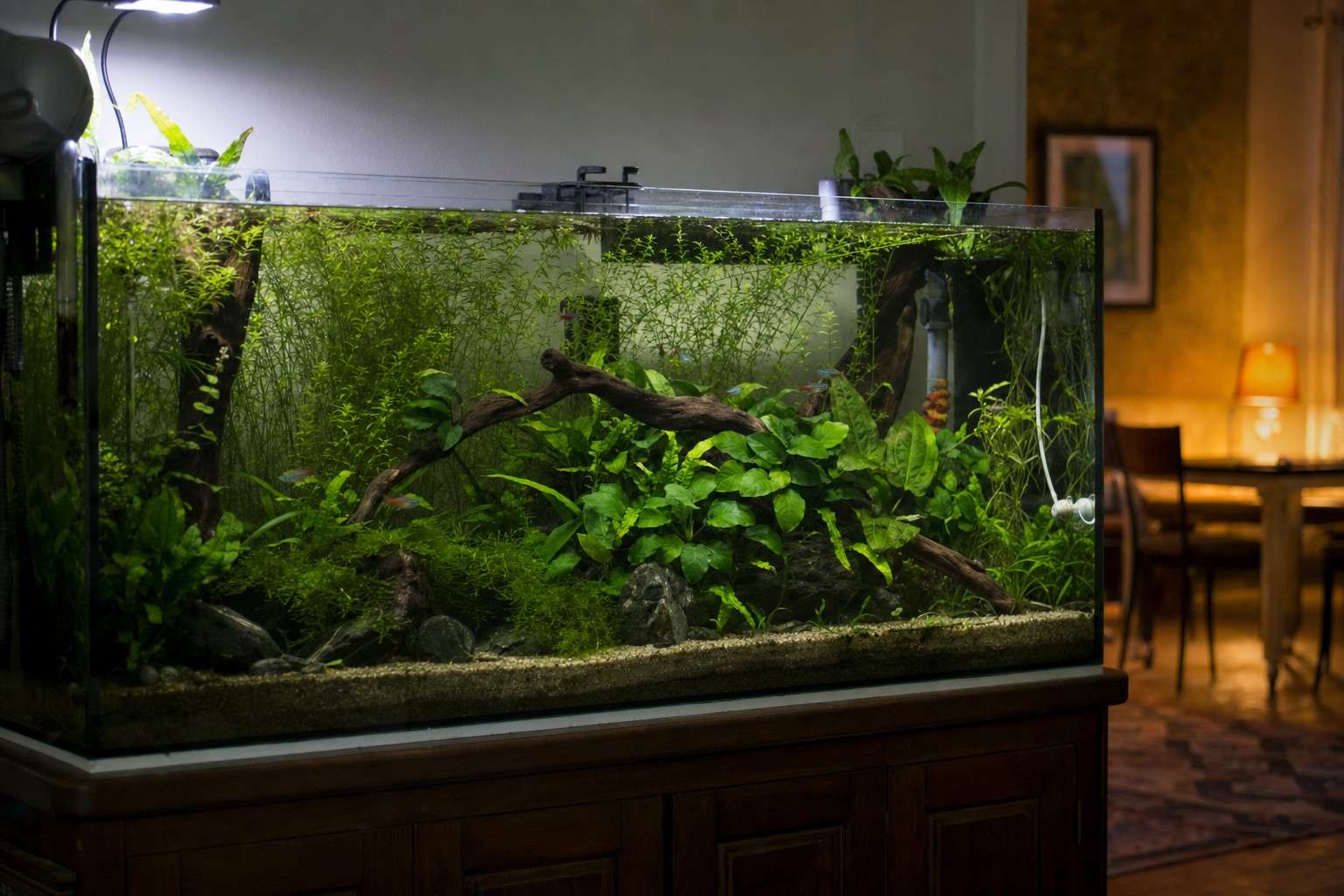
Live plants are one of the few things in this hobby that do your work for you.
That is the counterintuitive truth behind the planted tank movement that has gone mainstream over the last decade or so. A tank with living plants is not more demanding than a bare one. For most beginners, it is noticeably less. The plants compete directly with algae for the same nutrients, help settle water chemistry, and give fish places to retreat. A planted tank often looks better with less maintenance than a setup full of plastic decorations and bare glass.
So if you have been putting off live plants because they sounded like something experts do, the honest picture is the opposite. The right species are forgiving, slow to fail, and genuinely useful from week one.
Why Plants Make Things Calmer
Algae grows when nutrients build up with nothing to use them.
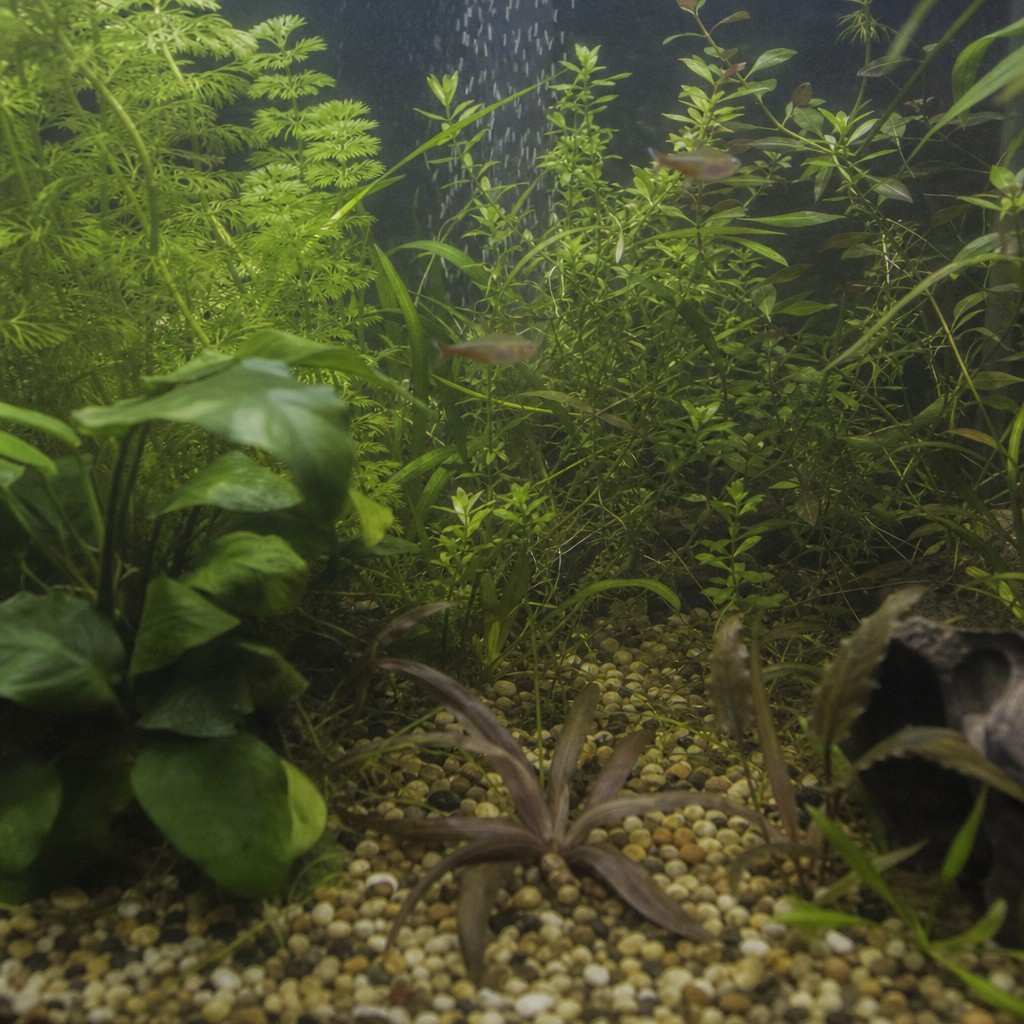
That is the simple version of a chemistry problem every new tank owner runs into. Uneaten food and fish waste release nitrogen compounds into the water. When a tank is young and lightly stocked, those compounds accumulate faster than the biological filter can process them. Algae, which is always present as invisible spores, takes the opportunity.
Live plants consume those same nutrients directly through their leaves and roots. They are not a substitute for good tank maintenance, but they are a competitor that runs continuously in the background. Less available nitrogen means less algae, less often.
Plants help fish, too. Dense growth near the back or sides of a tank gives fish places to shelter. Fish under less stress are more active, show better color, and are harder to kill. The effect is real and visible within a few weeks of planting.
The broader idea, a heavily planted, low-tech setup maintained without CO2 injection or complicated fertilizer regimes, is sometimes called the natural planted tank approach. Hobbyists have been running these setups for decades, and the method is now common enough that most aquarium shops stock the plants to support it. It is not a trend. It is just a settled, practical way to keep freshwater fish.
Plants fit into cycling well, too. Adding a few fast-growing stems to a tank while it cycles through the fishless cycling method gives the bacteria colony something to anchor to and keeps nitrogen moving even before any fish arrive.
Six Species Worth Buying First
These six plants cover the main categories: one for the foreground, a couple for mid-tank, fast-growth workhorses, and a background anchor. None of them need CO2. None need specialist fertilizers for basic growth.
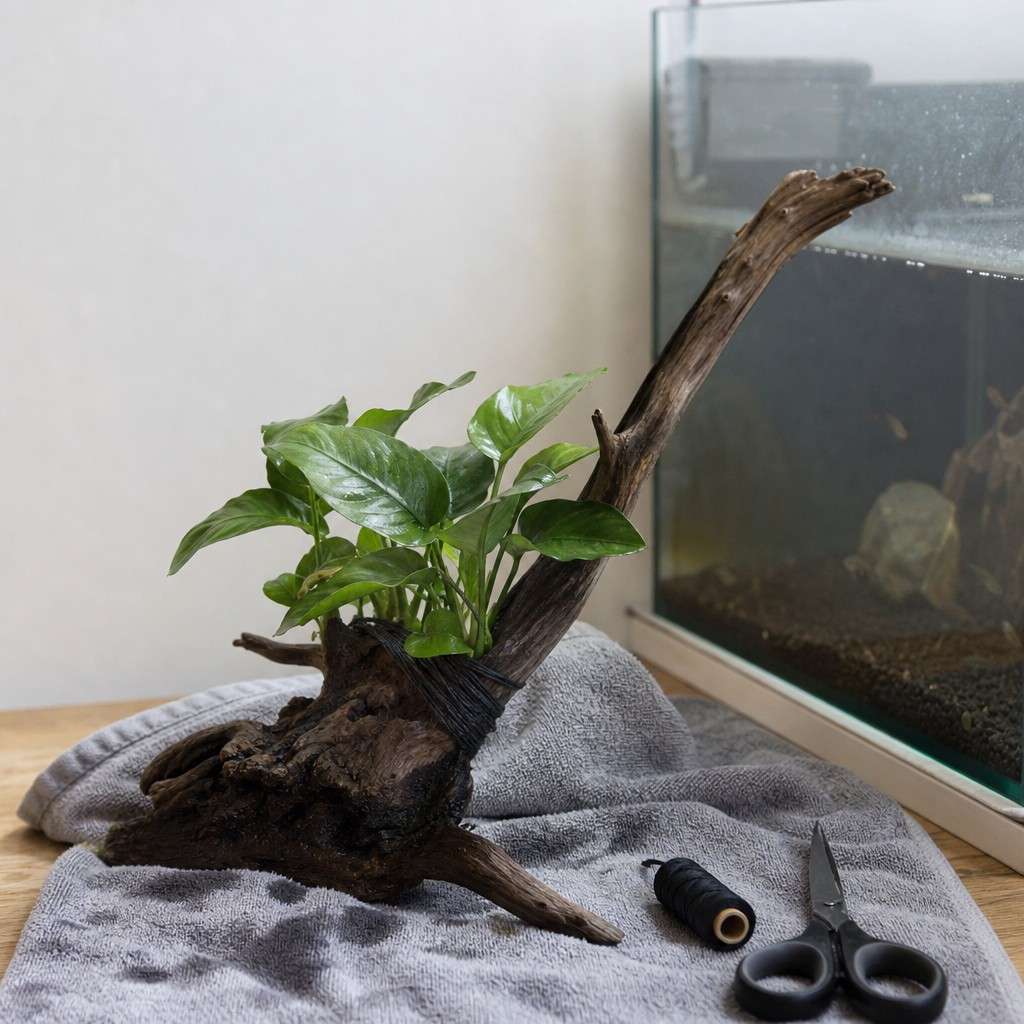
Java fern is probably the most beginner-proof plant in the hobby. It attaches to driftwood or rock with its rhizome, the horizontal stem at the base, and does not need to be planted in substrate at all. In fact, burying that rhizome will kill it. Tie it loosely to a piece of wood with a strip of sewing thread and it takes care of itself. Low to moderate light. Tolerates most tap-water conditions.
Anubias works the same way. Rhizome out of the substrate, tied to hardscape, left alone. It grows slowly and stays small, which makes it good for the foreground or as a mid-tank accent. Its thick, waxy leaves are almost impervious to abuse and are one of the few plants that fish cannot easily destroy. Both java fern and anubias do fine under a basic LED, which most modern tanks already come with.
Java moss is optional but useful. It grows on anything and softens hard edges: the corners of the tank, pieces of wood, even a flat rock. It provides shelter for small fish and, if you ever want to try breeding, cover for fry. Low light, no substrate needed, and it will not take over if kept in reasonable proportion.
Hornwort is a floater by nature. It can be planted, but it grows faster and does more work left to drift at the surface. Fast-growing plants remove nutrients at the highest rate, and hornwort is one of the fastest. It sheds fine needles as it grows, so it is worth running a gentle filter intake near the surface to catch them. Treat it as the tank’s nutrient sponge.
Amazon sword is a background plant for tanks with substrate and enough room. It gets large, which is the point. A single sword in the back corner of a 20-gallon tank provides the visual weight that would otherwise come from stacking plastic decorations. It does need to be planted in substrate, and it benefits from a root tab (a slow-release fertilizer pellet pressed into the gravel near the roots) once it is established. Low to moderate light.
Pothos is technically a houseplant, but it is one of the more useful additions to a tank with open space above the waterline. Trim a cutting, let the roots hang into the water while the leaves grow above, and it pulls nitrogen compounds directly from the tank through those roots. It never grows submerged, which keeps it from competing with the other plants for light. It is widely sold as a normal houseplant and is almost impossible to kill.
Java fern and anubias both attach to driftwood or rock and do not need to be planted in substrate at all. Tie them loosely to a piece of wood and they take care of themselves.
What They Actually Need
The single biggest change that made low-tech planted tanks accessible is the improvement in LED lighting.
The older fluorescent tubes that once dominated aquarium hoods put out inconsistent light and had to be replaced on a schedule. LED fixtures have made decent planted-tank light cheap and reliable, and most hood lights sold now are LED by default. For the species listed here, a standard hood light is enough. Java fern, anubias, and java moss all fall into the low-to-moderate light range. Even amazon sword does fine without a high-output fixture.
You will see references to CO2 injection systems and liquid fertilizer regimes in planted-tank forums. Those are real tools for demanding, fast-growing plants in high-light setups. For the species here, they are not required and mostly not beneficial. Adding CO2 to a low-light setup can cause problems without adding the extra light to use it. Skip that part entirely for a first planted tank.
Substrate matters a little. Java fern, anubias, java moss, hornwort, and pothos do not care what is at the bottom of the tank since they are not rooted in it. Amazon sword prefers a finer gravel or a dedicated plant substrate, and the root tab helps. Plain aquarium gravel works for the others.
The lighting that makes all of this possible is part of a broader hardware shift. A full rundown on what has changed in aquarium gear since the older fluorescent era is useful context if you are setting up a new tank after years away.
Two Honest Cautions
Not everything sold as an aquarium plant is one.
Pet stores commonly stock plants that grow naturally in wet soil near water but cannot survive fully submerged. Mondo grass, lucky bamboo, and some varieties sold as “aquarium plants” in the houseplant section fall into this category. They look fine for the first few weeks, then slowly rot. If you’re not certain a plant is truly aquatic, hold off until you can verify it.
Melting is normal. Many aquarium plants grow in two forms: an emersed form with leaves adapted for air, and a submerged form with different, softer leaves. Plants grown above water in a nursery are in emersed form. When you put them in a tank, they often drop their old leaves before growing new ones suited to submerged life. It can look alarming. It is usually not a problem. Give the plant a few weeks and new growth will come in, shaped differently than what you started with.
Leave the decaying old leaves in place until the new ones appear. Removing them early stresses the plant when it is already adapting.
A Planted Tank Is Not A Harder Tank
“An aquarium should be a calm corner of your home, not a second job.”
That principle does not conflict with live plants. It points toward them.
A tank with a handful of easy plants runs more steadily than one without. Algae is less of a constant fight. Fish are calmer. Water changes matter because they work with an existing system, not because you are chasing an unstable one.
A stable tank beats an impressive one. The species here are easy because they are stable: slow to fail, tolerant of ordinary tap water, and indifferent to the variations in light and temperature that beginner tanks go through.
Start with java fern and hornwort if you want the lowest possible barrier. Add anubias once you have a piece of driftwood worth attaching it to. Build the rest of the tank around what grows.
The plastic alternative is not wrong. But the planted version often turns out to be easier, and it tends to look better in the long run.