
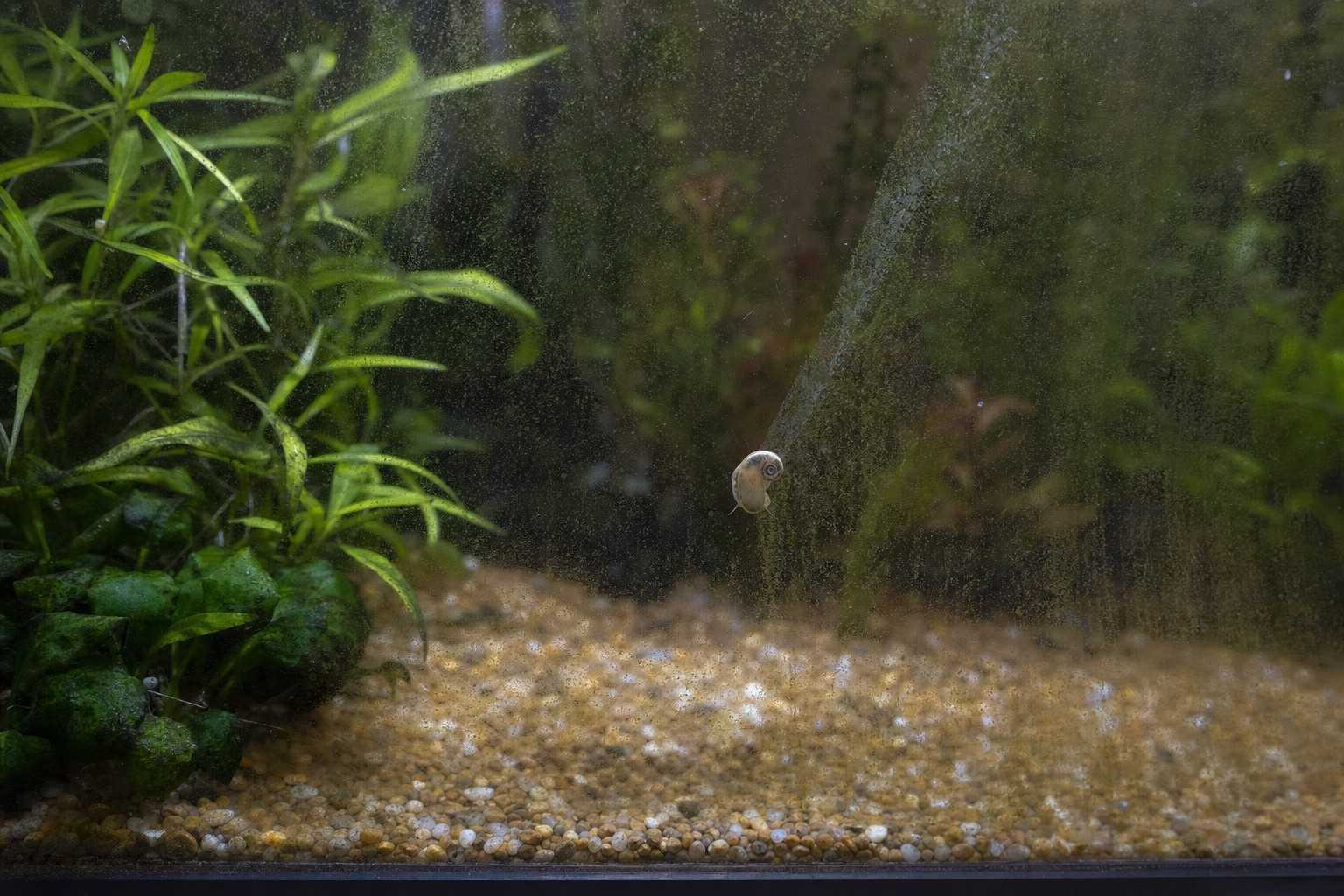
Seeing a small snail glide across your tank glass for the first time tends to land somewhere between curiosity and mild alarm. The honest answer to “friend or pest?” is: genuinely both, depending on conditions you control.
That framing matters, because the snail itself is rarely the issue. A few tiny snails working the substrate is not a sign of a dirty tank or a mistake you made. It is a sign your tank has food available, which every aquarium does.
Where They Come From
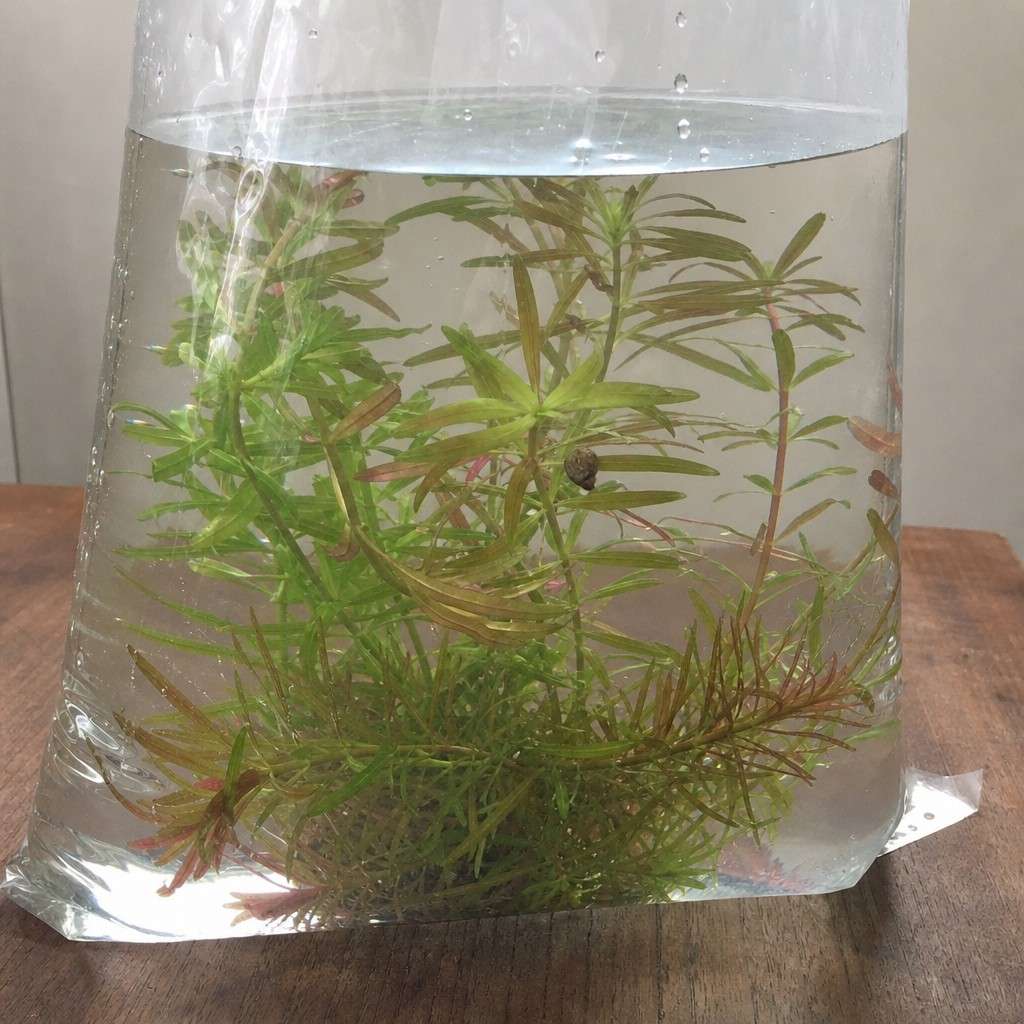
The snails already in your tank arrived uninvited, and they almost certainly came in on plants.
Aquarium plants are the most common entry point for hitchhiker snails. The snails themselves are easy to miss at the store, but their eggs are nearly invisible: tiny clusters pressed against leaf undersides or tank glass that go unnoticed on a visual check. Decor and gravel bought secondhand can carry eggs too.
This is not a contamination failure on your part. It is just how the hobby works. Any planted tank that receives new plants over time will eventually see a snail. The species that arrive this way are almost always one of three: bladder snails (small, translucent, with a lopsided shell), ramshorn snails (flat, coiled, often dark or reddish), or Malaysian trumpet snails (elongated, cone-shaped, tend to bury themselves in the substrate during the day).
None of these were introduced intentionally. All of them, in modest numbers, are doing something useful.
The Friend Side
A small snail population earns its place in the tank.
Bladder and ramshorn snails eat algae from glass and leaves, pick off uneaten food before it can foul the water, and consume decaying plant matter. They are, in effect, a low-profile maintenance crew. In a healthy, well-balanced tank they stay at low numbers because that is what the food supply supports.
Malaysian trumpet snails earn a specific mention. They spend most of the day burrowed into the substrate and come out at night, turning the gravel as they go. That light aeration prevents compacted patches where anaerobic pockets can develop. A handful of trumpet snails doing this is genuinely good for the tank bed.
A few snails is, in this sense, a quiet signal that your cleanup chain is working. They are part of how a stable tank manages itself, alongside the bacteria in the filter and the algae-eating role covered more fully in the aquarium algae control guide.
A few snails is a quiet signal that your cleanup chain is working.
The Pest Side (And What Actually Causes It)
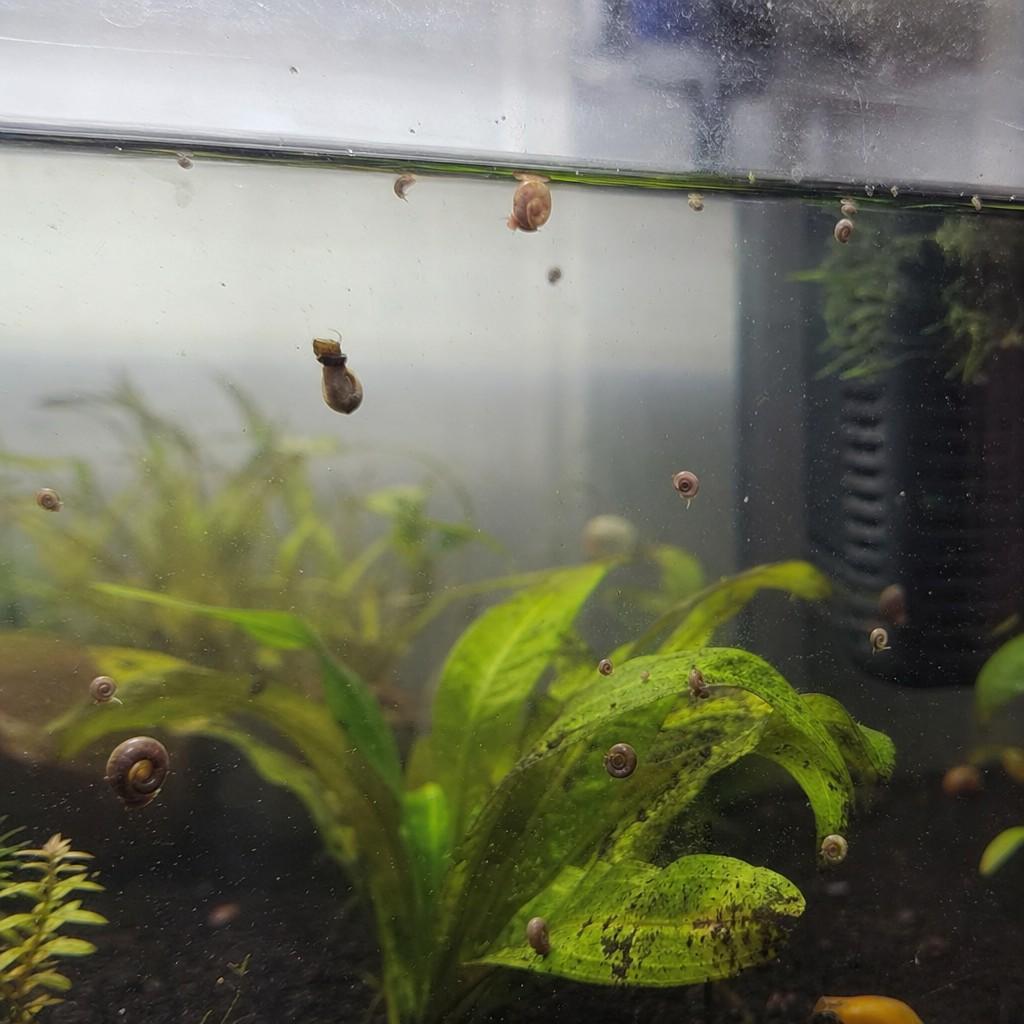
The thing that makes snails a problem is not the snails themselves. It is the food supply.
A snail population tracks its food source almost directly. More uneaten food and more decaying plant matter means more snails, fast. Bladder snails in particular reproduce quickly, and a tank that goes from a handful to a carpet of them in a few weeks has a feeding problem, not a snail problem.
This connects to the same principle that runs through most of what goes wrong in a freshwater tank. Most fish problems are water problems, and overfeeding sits near the top of the water-quality threat list. Uneaten food breaks down into ammonia. It feeds snail colonies. It fuels algae blooms.
The snail boom is a symptom. The food going into the tank is the variable to look at first.
Overfeeding is one of the most common beginner habits, and it is easy to fall into because fish respond to food so visibly. The practical check is to feed only what disappears in two to three minutes and watch whether anything settles on the substrate. A clean substrate after feeding is a good sign. A layer of food resting on the gravel is a snail invitation. The feeding and tank maintenance routine sections of your weekly habit are the right place to tighten this up.
Snails You Might Actually Want
Not all aquarium snails are hitchhikers. Some are deliberately kept, and they behave very differently.
Nerite snails are the most recommended intentional snail for a beginner tank. They eat algae efficiently, including the flat green kind that coats glass, and they do not overrun a tank because they do not breed in freshwater. Nerite eggs are laid on hard surfaces and look like tiny white sesame seeds, but they require brackish water to hatch. In a standard freshwater setup, the eggs are a minor aesthetic nuisance but the population stays flat.
Mystery snails (also called apple snails) are larger, reaching golf-ball size in some cases, and come in a range of colors: gold, ivory, blue-grey, brown. They are peaceful, slow-moving, and easy to keep alongside most community fish. They do breed in freshwater, but they lay their eggs above the waterline in a visible pink-to-cream cluster, which makes population management straightforward. If you do not want more snails, you remove the egg mass before it hatches.
Both of these are sold in stores and chosen on purpose. The distinction matters when you are trying to figure out what arrived in your tank: a single dark ramshorn the size of a pea came in on a plant; a bright gold snail the size of a marble that you do not remember buying is harder to explain.
Getting Numbers Under Control
If the population has already grown large, the fix starts with the food supply, not with chemical treatments.
Cut back on feeding first. If the colony has nothing extra to eat, it contracts on its own. This is the step most advice skips past too quickly, but it is the most effective one over two to three weeks.
Manual removal helps in the meantime. Pick snails off the glass by hand during a water change. It is tedious for a day or two but puts a dent in the population. A piece of blanched zucchini or cucumber left on the substrate overnight works as a trap: snails congregate on it and can be lifted out in the morning before the day’s food goes in.
For persistent infestations, biology is more effective than chemistry. Assassin snails eat pest snails, one at a time, and a few of them in a tank will steadily work through a ramshorn or bladder snail population without multiplying out of control themselves. Certain loaches, including clown loaches and khuli loaches, hunt snails actively and enjoy doing it. The practical caveat: loaches get large and need a properly sized tank for the long term, so they are a livestock decision, not just a pest control move.
Chemical snail killers are sold, and they work. The tradeoff is that they also affect water quality and can harm shrimp and other invertebrates if any are in the tank. For a beginner working through a snail boom, the non-chemical route is both safer and more educational, since it leads back to the feeding adjustment that solves the root issue.
The Honest Frame
Snails are one of the hobby’s more useful messengers.
A small population is normal and mostly beneficial. A population explosion is the tank telling you that excess food is building up somewhere in the system. Fix the feeding, and the snails become a minor background feature rather than a problem.
An aquarium should be a calm corner of your home, not a second job, and snail control rarely needs to become one. Tighten the feeding schedule, remove the obvious ones by hand over a few weeks, and let the population settle to the level the tank actually supports. For most setups, that level is low enough to be invisible most of the time.
The snails that showed up uninvited are not a sign of failure. They are doing exactly what they were going to do the moment a food source appeared. What you do with the food source is the part that is up to you.